How Cybercriminals Turn Your Employees’ Passwords Into Profit
In today’s rapidly changing digital world, data has become one of your most valuable assets—and one of the easiest for criminals to target. As organisations modernise and rely more on cloud services, remote work, and mobile access, cyber threats have evolved with them. One of the biggest risks today is credential theft: criminals stealing usernames and passwords to get into your systems.

What many business leaders don’t see is the industrialised ecosystem behind these attacks. Credentials aren’t just stolen—they are harvested, traded, and used in a bustling, efficient cybercrime marketplace. Criminal groups deploy “information stealers,” specialised malware designed to quietly collect login details from browsers, password managers, cookies, and apps. These stolen credentials are then packaged and sold on dark-web markets, often for just a few dollars per account.
Attackers who buy these access packages can immediately start probing your systems. And with automated scanning tools and AI-driven attack scripts, they can quickly identify weak points, escalate access, and deliver ransomware. The entire process, from credential theft to ransom demand, has become faster, more efficient, and more profitable than ever.
This is not a niche problem. According to Verizon’s 2025 Data Breach Investigations Report, more than 70% of data breaches now involve stolen credentials. For any organisation, the consequences can be severe: operational shutdowns, financial losses, regulatory penalties, and long-term reputational harm. Put simply, passwords on their own are no longer enough.
The Lifecycle of Stolen Credentials
Credential theft rarely looks like a dramatic “hack.” It is usually a gradual, covert process. Today’s attack chain often begins with information-stealing malware that quietly collects usernames, passwords, browser cookies, and session tokens. Once collected, this data is:
Automatically uploaded to criminal servers
Sorted and packaged into “access bundles”
Sold on dark-web marketplaces to buyers looking for corporate access
Attackers then use these credentials to impersonate employees, bypass security controls, and move deeper into systems. Tactics include:
• Phishing Emails: Trick people into entering credentials into fake sites.
• Keylogging: Record keystrokes to capture logins.
• Credential Stuffing: Use leaked passwords from other breaches to log in.
• Man-in-the-Middle Attacks: Intercept logins on insecure networks.
Once attackers have access, sophisticated automated tools (often enhanced by AI) scan for vulnerabilities, escalate privileges, and prepare systems for ransomware deployment. The entire pipeline is optimised for profit.
Traditional Authentication Limitations
For years, companies relied on usernames and passwords alone. That approach is no longer sufficient. Cyber criminals know that:
• People reuse passwords across multiple systems.
• Many passwords are easy to guess.
• Passwords can be phished, stolen, or purchased cheaply online.
As long as your organisation relies on passwords alone, you are vulnerable—not because your systems are weak, but because attackers have turned credential theft into a highly efficient business model.
Advanced Protection Strategies for Business Logins
To counter this industrialised threat, organisations need stronger, modern authentication methods.
Multi-Factor Authentication (MFA)
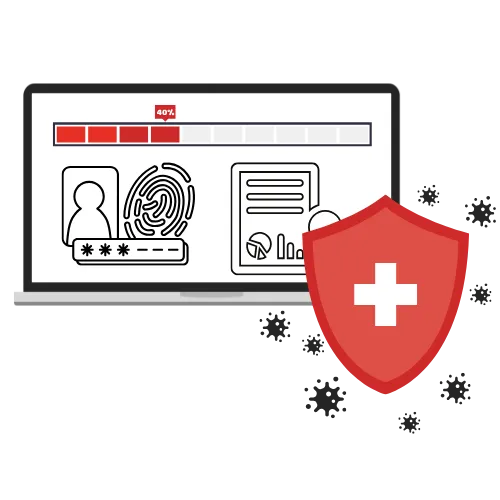
MFA adds an extra check—like a fingerprint or a one-time code—so even if criminals buy or steal a password, they can’t log in. It dramatically reduces the success rate of credential-based attacks.
Phishing-Resistant MFA
Not all MFA is equal. SMS codes and email prompts can still be intercepted or spoofed. Phishing-resistant MFA uses cryptographic verification that attackers cannot trick or replay, even if a user is fooled.
Examples include USB security keys (like Yubikeys), built-in device authenticators (such as Windows Hello, FaceID, TouchID), or passkeys (which are now supported in Microsoft Authenticator).
When applied to all users, this form of MFA makes stolen passwords worthless because they can't be used without the physical device or cryptographic key. This reduces the risk of ransomware, business email compromise, and financial fraud.
Behavioral Analytics and Anomaly Detection
Security monitoring tools can automatically detect suspicious behaviour, such as:
• Logins from unusual countries
• Access attempts outside normal hours
• Repeated failed logins
This gives security teams an early warning before attackers can exploit purchased or stolen credentials.
The Role of Employee Training
Even with advanced tools, people remain a key defence. Training employees to recognise phishing attempts, use password managers, avoid recycling passwords, and understand MFA dramatically reduces your exposure.
Credential Theft Will Happen
Cyber criminals have built an efficient, profitable marketplace around selling access to corporate systems. Combined with automation and AI, credential-based attacks are now faster, cheaper, and more damaging than ever.
If criminals can buy your employees’ stolen credentials for a few dollars, they can buy their way into your business, deploy ransomware, and turn it into a major financial event.
Modern authentication, especially phishing-resistant MFA, breaks this business model.
By strengthening authentication, and using smarter monitoring tools, you can keep your organisation's accounts, credentials, and data off of the dark web.
Contact us today to learn how to protect your organisation from this rapidly growing threat.