
Little Green Dots & Treating People Like Adults
Someone posted a thing on LinkedIn this week that I haven't quite been able to stop thinking about. They were after a quiet word with whichever Microsoft engineer decided that your Teams status should slide from green to amber after two minutes of inactivity. It was a joke... mostly. But there's a real anxiety sitting underneath it, and it's worth naming plainly: a great many people genuinely worry that a colour-changing dot is being used to decide whether they're pulling their weight.
My reply was blunt. If your employer is sitting there watching Teams statuses and forming judgements off the back of them, you're working for the wrong company.
I'd like to explain what I mean by that, because it goes right to the heart of how we've chosen to build Nova Blue.
We hire adults
We don't hire clever, capable people and then manage them as though they were children. Said out loud, that sounds obvious. And yet an extraordinary amount of corporate life is built on precisely the opposite assumption — that people will down tools the moment nobody's looking, so somebody had better keep looking. Time sheets. Mandatory hours. The little green dot. It all comes from the same shitty place: a belief that, deep down, your people can't be trusted.
We've taken a different view. We hire smart, responsible adults, and we treat them with dignity, fidelity and trust. This sentiment is the foundation the whole "Nova Legion" thing stands on.
No working hours. No holiday allowance.
In practice, this leads to a couple of things that tend to raise eyebrows.
We don't have set working hours. We don't have an annual leave allowance. There's no spreadsheet tallying up your days off, and nobody noting the time you log on of a morning.
The logic is simple enough. If I genuinely believe the people I've hired are responsible, then I have to let them be responsible — about when they work, how they choose to engage with that work, and where they do it. You can't tell someone you trust them and then quietly audit their diary. The two things don't sit together.
Don't get me wrong — we have commitments to clients that we need to maintain, and most people in the UK and Europe work a 9–5. But while we absolutely must never trade on or mortgage our commitments to our wonderful clients, I want my team to feel like they can choose when they work, how they work, and where they work.
I'll be honest with you: this won't suit every business. For example, if you are on an assembly line and the thing you do doesn't get done when you aren't in that exact place at that exact time, this won't work — and I'm not going to pretend otherwise. There are whole industries and roles where it simply can't apply. But for us, it works. And it works rather well.
It is genuinely hard to get right
None of this is the soft option, which is the bit people tend to miss when they hear "no fixed hours". My wife is an HR professional, and this gives her some shudders sometimes. It's the opposite of soft or easy.
For this level of autonomy and trust to work, everybody has to understand what we're actually trying to achieve — not just the task in front of them, but the strategic picture, the place we're trying to reach. Without that, freedom curdles into aimless drift. With it — when people know where we're headed and are all pulling in the same direction — you get something you cannot manufacture through monitoring and mandated hours. You get people who care about the outcome, who use their own judgement, who do their best work precisely because it's theirs.
When you get this right, the results are well beyond anything the command-and-control approach will ever produce. I've worked under both. It isn't close.
How I see my own job
Which brings me to my own role in all this.
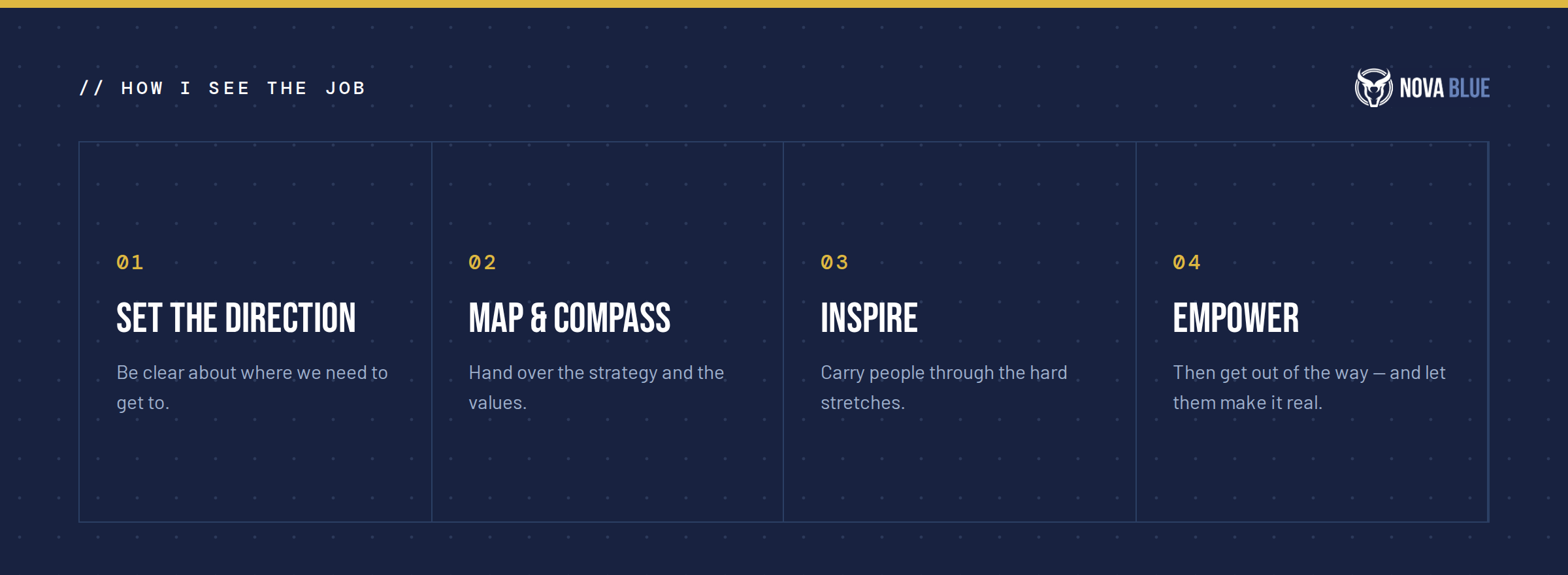
I don't believe my job as CEO is to tell people when to be at their desks. My job is to set the vision — to be clear about where we need to get to. Then to hand people the two things they need for the journey: a map, which is our strategy, and a compass, which are our values. The road will be hard in stretches, and part of the work is to inspire people to keep walking through the difficult bits. And then — the part that matters most — to get out of the way and empower them to turn that vision into something real. My job isn't to create success. My job is to set the conditions for other people's success.
Set the direction. Hand over the map and the compass. Inspire, then empower. That, to my mind, is the most important part of my job.
The rest of it — including the colour of anyone's Teams status — I'm very content to leave well alone.
So, to whichever Microsoft engineer is responsible for the amber dot: you're absolutely fine. Nobody here is watching or caring.